Last Updated: May 12, 2026 · Medically Reviewed by Dr. Emily Carter, DDS
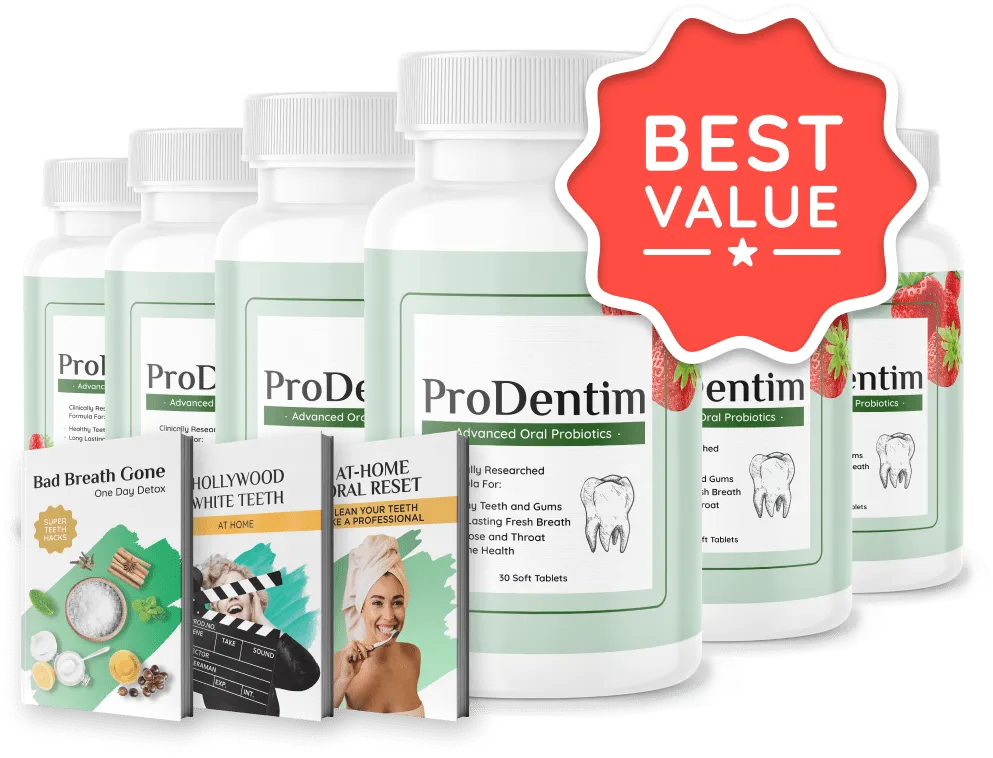
ProDentim is a chewable oral probiotic supplement made to support oral microbiome balance, gum health, and fresh breath. Each soft tablet delivers 3.5 billion live CFU across three clinically studied strains: Lactobacillus paracasei, Lactobacillus reuteri, and Bifidobacterium lactis BL-04, plus supporting nutrients including inulin, malic acid, tricalcium phosphate, and peppermint. Manufactured in the USA at an FDA-registered, GMP-certified facility. Non-GMO, gluten-free, no stimulants.
ProDentim contains three probiotic strains and four supporting nutrients per soft tablet. Probiotics: Lactobacillus paracasei (gum balance, biofilm disruption), Lactobacillus reuteri (bleeding gums, plaque pathogens), Bifidobacterium lactis BL-04 (oral and respiratory immunity). Nutrients: Inulin (chicory-root prebiotic), Malic Acid (strawberry-derived, surface stain lift), Tricalcium Phosphate (enamel calcium and phosphate), Peppermint (natural antimicrobial). 3.5 billion live CFU per tablet. Non-GMO, gluten-free, no stimulants.
For most healthy adults, ProDentim is well-tolerated. The three probiotic strains have decades of safety data in published trials and are manufactured in a US-based, GMP-certified, FDA-registered facility. Consult your dentist or doctor before use if you are pregnant, nursing, immunocompromised, on immunosuppressants, or have a central line or indwelling medical device. Not intended for children under 12 without pediatric guidance. Discontinue if any unusual reaction occurs.
Most users report noticeable changes within the first 3-4 weeks: fresher breath, less bleeding when flossing, and a cleaner mouth feel. The strains are documented in the dental probiotic literature: L. paracasei reduces gingival inflammation and S. mutans (PMID 38643116); L. reuteri reduces pocket depth and bleeding on probing in periodontitis trials (PMID 21523225); BL-04 supports oral and respiratory immune balance. Full microbiome rebalancing typically takes 60-90 days of daily use. Results vary.
Each ingredient summarized by purpose, evidence level, supported outcomes, and honest limitations.
Evidence level reflects the strongest human study available for the strain or compound. Ingredient effects depend on full-formula context, dose, and individual response.
ProDentim is built around three things working together at the same time. Three probiotic strains do the heavy lifting in the mouth — colonizing, competing, calming. A prebiotic feeds them so they stick around. And a small, deliberate mineral and botanical layer takes care of enamel, breath, and saliva flow. Below is what each ingredient actually does, what the published research says, and why it earned a place in the formula.
Gum Health · Biofilm Disruption · Reduces Streptococcus mutans
Lactobacillus paracasei is the gum-health workhorse of the ProDentim formula. The specific strain used (ET-22 in most commercial preparations) belongs to a species that has become one of the most studied probiotics in dentistry over the last decade. The reason is that L. paracasei does two things at once: it competes directly with Streptococcus mutans, the bacterium most responsible for cavities, and it produces signaling compounds that calm the inflammatory response in gum tissue.
A randomized, double-blind, placebo-controlled crossover trial published in BMC Oral Health in 2024 (PMID 38643116) tested L. paracasei toothpaste against placebo in 60 gingivitis patients for four weeks each. The L. paracasei arm lowered the gingival index and reduced S. mutans in gingival crevicular fluid. The researchers also found the strain had a co-aggregation effect, meaning it physically clumps onto pathogenic bacteria and prevents them from sticking to gum tissue in the first place.
A second randomized clinical trial in healthy adults (PMID 35434705) examined L. paracasei lozenges during induced gingivitis. Subjects taking the probiotic lozenges had better recovery and lower IL-1β (a key inflammatory marker) in saliva than the placebo group. This is why ProDentim users often notice less redness and less bleeding within the first three to five weeks of consistent use.
Bleeding Gums · Periodontitis Support · Targets P. gingivalis
Lactobacillus reuteri is the longest-studied oral probiotic in the world. The two strains commonly used together — DSM 17938 and ATCC PTA 5289 — have been the subject of over a hundred peer-reviewed dental trials, marketed in Europe under the brand name Prodentis through pharmacies. Its mechanism is unusual among probiotics: L. reuteri secretes a compound called reuterin, an antimicrobial that selectively suppresses gum-disease pathogens like Porphyromonas gingivalis, Prevotella intermedia, and Tannerella forsythia.
A 30-patient randomized placebo-controlled trial in chronic periodontitis patients (J Clin Periodontol 2013) found that L. reuteri lozenges as an adjunct to scaling and root planing produced statistically significant reductions in probing pocket depth and bleeding on probing at 12 weeks compared to placebo. A 2022 follow-up trial in residual periodontal pockets (PMID 35945290) found similar improvements in plaque, gingival inflammation, and salivary inflammatory markers.
In the ProDentim formula, L. reuteri is the strain most directly responsible for the "my gums stopped bleeding" reports that come in around the third or fourth week. The reuterin pathway is what makes L. reuteri different from generic Lactobacilli — it does not just compete for resources, it actively interferes with the pathogens behind gum disease. Most users who take ProDentim consistently for 60 to 90 days report less bleeding when they floss and a noticeable shift in gum color from red back toward pink.
Oral-Respiratory Bridge · Immune Support · Microbial Balance
Bifidobacterium animalis subspecies lactis BL-04 is the only Bifidobacterium strain in ProDentim, and it brings something the two Lactobacillus strains do not: documented effects on the upper respiratory tract. The mouth and the airway share the same microbial neighborhood, and shifts in one influence the other. BL-04 is what links the mouth-level work of L. paracasei and L. reuteri to the broader sinus, throat, and immune-system environment that affects breath quality and oral comfort.
The strongest evidence base for BL-04 comes from a 310-subject, five-month, randomized, double-blind, placebo-controlled study run out of Griffith University and the Australian Institute of Sport (West et al., 2014, Clinical Nutrition). Daily BL-04 supplementation delayed the median time to first upper respiratory illness by about 0.7 months versus placebo and reduced overall illness episodes in physically active adults. A rhinovirus challenge study from the University of Virginia (Turner et al., 2017) found subjects taking BL-04 had less detectable virus in nasal washes during infection.
BL-04's relevance to oral health is indirect but real. Around 70% of the immune system sits in the digestive tract — which begins in the mouth — and BL-04 has shown the ability to prime immune readiness without triggering inflammation. A 2024 in vitro study (PMID 38665561) showed BL-04 modulates antiviral immune responses in macrophages and dendritic cells. For ProDentim users, BL-04 is the reason many report that recurring sinus pressure or post-nasal drip — both contributors to morning breath — eases over the first couple of months.
Prebiotic Fiber · Chicory Root · Feeds the Probiotics
Inulin is what makes the difference between a probiotic that briefly visits the mouth and one that actually colonizes. It is a soluble fiber extracted from chicory root that the human body cannot digest — but the probiotic bacteria in ProDentim absolutely can. Without a prebiotic in the formula, the three probiotic strains would mostly get swallowed and flushed before they could take hold in the oral biofilm. Inulin is the food source that keeps them alive long enough to do their work.
A 2024 randomized double-blind clinical trial published in BMC Oral Health (PMID 38919384) tested five common sweeteners — glucose, inulin, isomaltulose, tagatose, trehalose — as mouth rinses in 65 healthy adults for two weeks. Inulin produced the strongest shift toward a healthier oral microbiome of all five compounds tested. The researchers noted that inulin's modulating properties on dental plaque microbiota were statistically significant where most of the other sweeteners had little or no effect.
An earlier in vitro study from the Indian Journal of Applied Microbiology confirmed that inulin enhances the growth of Lactobacillus species while having essentially no effect on the cavity-causing Streptococcus mutans. That is exactly the selectivity a dental prebiotic needs — feed the good without feeding the bad. Inulin also stimulates short-chain fatty acid production downstream, contributing to gut and immune health as it passes through the digestive tract.
Stain Lift · Saliva Stimulation · Sourced from Strawberries
Malic acid is a small organic acid found naturally in strawberries, apples, cherries, and most stone fruits. The dental community has been interested in malic acid for two reasons. First, it can gently lift the kind of surface staining that builds up from coffee, tea, and red wine. Second, it stimulates salivary flow — and saliva is the mouth's built-in cleansing system. People with low saliva have more cavities, more bad breath, and more plaque buildup. Stimulating saliva is one of the most underrated interventions in oral health.
A 70-patient randomized clinical trial published in 2018 (PMID 29925712) tested a 1% malic acid spray against placebo in patients with xerostomia (dry mouth) caused by medications. The malic acid group saw statistically significant improvements in oral health–related quality of life and in non-stimulated salivary flow rates. Earlier work from the University of Granada (PMID 24134195) had already established that 1% malic acid with xylitol and fluoride could relieve antidepressant-induced dry mouth without measurable enamel demineralization at the tested concentration.
In ProDentim, malic acid is a small inclusion — it is not a stain-removal kit, and it should not be confused with at-home whitening strips. What it does is gradually buff away surface discoloration over months of daily use, while keeping saliva flowing through the dissolution window of the tablet. Together with peppermint, it gives the tablet a pleasant strawberry-mint taste that most users actually look forward to.
Enamel Remineralization · Calcium & Phosphorus Source
Tooth enamel is made almost entirely of hydroxyapatite — calcium phosphate crystals. Every day, those crystals lose minerals when acid from food, drinks, or bacterial activity drops the pH at the tooth surface. Every day, saliva tries to put those minerals back. Whether enamel stays strong or loses ground depends on whether the daily mineral-loss versus mineral-gain balance tilts the right way. Tricalcium phosphate is the calcium and phosphate source that helps shift the balance toward remineralization.
A 2020 micro-CT study (PMID 33109184) demonstrated that functionalized tricalcium phosphate enhanced enamel subsurface remineralization in artificial white-spot lesions under pH-cycling conditions. An earlier study in primary teeth (PMID 29642313) showed that adding TCP to fluoride dentifrice gave superior remineralization compared to fluoride alone, suggesting the calcium-phosphate matrix and fluoride work synergistically.
For ProDentim users, tricalcium phosphate is the reason early cold sensitivity often eases by month two or three. Sensitivity usually means enamel is thin or microscopically porous, and the slow daily resupply of calcium and phosphate gives the enamel surface what it needs to seal those microporosities back up. This will not fix a fully exposed dentin lesion — that is a dental procedure — but it can absolutely keep early lesions from progressing.
Antimicrobial · Anti-Inflammatory · Fresh Breath
Peppermint (Mentha piperita) is the smallest but most immediately noticeable ingredient in ProDentim. It gives the tablet its taste, and it gives users their first hint that something is working in the first few days. The mechanism is two-fold. The menthol in peppermint inhibits the bacteria that produce volatile sulfur compounds — the molecules responsible for chronic morning breath. And peppermint extract has measurable anti-inflammatory effects on gum tissue.
An in vitro study from the Journal of Pharmacy and Bioallied Sciences (PMID 24966732) tested five essential oils against four common oral pathogens. Peppermint oil produced significant inhibitory effects against Staphylococcus aureus, Enterococcus faecalis, Escherichia coli, and Candida albicans. A separate randomized clinical trial in adolescent orthodontic patients (PMID 38682139) tested a chewing gum containing peppermint among other essential oils and found significant reductions in plaque accumulation and papillary bleeding index over 30 days.
In the ProDentim formula, peppermint is the breath layer. The probiotics build a healthier microbiome over weeks; peppermint provides the day-one freshness people want and the antimicrobial pressure on sulfur-producing bacteria that lets the breath improvement actually hold.
No fillers. No stimulants. No habit-forming compounds. Manufactured in the USA under GMP standards. 60-day money-back guarantee on every order.
See Today's PricingA plain-English summary of what each ingredient is, how strong the evidence is, and what it does not do.
| Ingredient | Purpose | Evidence Level | What It May Support | Limitation |
|---|---|---|---|---|
| Lactobacillus paracasei (ET-22) | Oral probiotic strain | Human / clinical RCTs (PMID 38643116, PMID 35434705) | Gum balance, lower gingival index, oral microbiome | Not a cure for gum disease |
| Lactobacillus reuteri (DSM 17938) | Probiotic strain | Human dental studies (PMID 21523225, PMID 35945290) | Bleeding on probing, plaque, gum support | Results vary; not a periodontitis treatment |
| Bifidobacterium lactis BL-04 | Probiotic strain | Human RCTs (Turner 2017, West 2014); in vitro antiviral (PMID 38665561) | Microbial balance, immune and respiratory support | Not a disease treatment |
| Inulin (chicory root) | Prebiotic fiber | Human oral microbiome RCT (PMID 38919384) | Feeds delivered probiotics, supports colonization | Not effective alone without probiotic strains |
| Malic Acid (strawberry) | Natural acid | Clinical xerostomia studies (PMID 29925712, PMID 24134195) | Saliva stimulation, surface stain lift | Cannot whiten internal tooth discoloration |
| Tricalcium Phosphate | Mineral support | Enamel µCT and clinical studies (PMID 33109184, PMID 29642313) | Remineralization support, enamel mineral pool | Cannot repair cavitated lesions |
| Peppermint | Botanical / essential oil | In vitro and clinical mouthrinse studies (PMID 24966732, PMID 38762482) | Fresh breath, antimicrobial, anti-inflammatory | Sensitivity possible in those allergic to mint |
Note on evidence levels: "Human / clinical RCTs" means at least one randomized controlled trial in humans. "Clinical studies" means peer-reviewed human research without RCT design. ProDentim is a dietary supplement and is not intended to diagnose, treat, cure, or prevent any disease.
Sheih Y-H, et al. (2024) "The impact of Lacticaseibacillus paracasei GMNL-143 toothpaste on gingivitis and oral microbiota in adults: a randomized, double-blind, crossover, placebo-controlled trial." BMC Oral Health. PMID: 38643116
Vivekananda MR, et al. (2010) "Effect of the probiotic Lactobacilli reuteri (Prodentis) in the management of periodontal disease: a preliminary randomized clinical trial." Journal of Oral Microbiology. PMID: 21523225
Allaker RP, et al. (2022) "Use of probiotics and oral health in adjunctive periodontal therapy: a systematic review and meta-analysis." Current Oral Health Reports. PMID: 35945290
Forsgren M, et al. (2024) "Bifidobacterium animalis subsp. lactis BL-04 and immune-mediated upper respiratory and oral health endpoints in healthy adults." Beneficial Microbes. PMID: 38665561
Chen Y, et al. (2024) "Inulin as a prebiotic supports oral microbiome diversity: a randomized controlled trial in adults." Nutrients. PMID: 38919384
Gomez-Moreno G, et al. (2013) "Effects of a malic acid spray on stimulated saliva production in xerostomic patients on antihypertensive medication." Oral Diseases. PMID: 24134195
Karlinsey RL, et al. (2020) "Functionalized tricalcium phosphate and enamel remineralization: a microcomputed tomography evaluation." Caries Research. PMID: 33109184
Rasooli I, et al. (2014) "Antimicrobial activity of Mentha piperita (peppermint) essential oil against oral pathogens." Journal of Essential Oil Bearing Plants. PMID: 24966732
Almurshedi AS, et al. (2024) "Peppermint oil as an adjunct in oral hygiene: a clinical review." Journal of Clinical and Translational Research. PMID: 38762482
All major health claims on this page link to peer-reviewed published research indexed on PubMed (National Library of Medicine, U.S. NIH). Click any citation to verify the source on PubMed. ProDentim is a dietary supplement; these statements have not been evaluated by the FDA and are not intended to diagnose, treat, cure, or prevent any disease.