Most adults notice their gums for the first time some time after 40. Pink suddenly becomes red. Bleeding shows up on a floss strand that never bled before. Sensitivity creeps in at the gumline. These are not random. After 40, several biological and lifestyle factors converge to make gum tissue more vulnerable, and the underlying microbial community more aggressive. This article explains what is actually changing in your mouth as you age, and what to do about it.
What Changes After 40
Salivary Flow Drops
Resting salivary flow declines gradually with age and drops sharply for adults on common medications: antihistamines, antidepressants (especially SSRIs and tricyclics), diuretics, blood pressure medications, opioids, and many sleep aids. Saliva is the main buffer against acid and the main delivery vehicle for the antimicrobial proteins (lactoferrin, lysozyme, defensins) that keep oral pathogens in check. Less saliva means more acid contact time and weaker first-line defense. The result is more cavities and more gum inflammation, often in people who have taken excellent care of their teeth for decades.
Gum Tissue Thins and Recedes
The gingival margin migrates apically (downward, away from the tooth crown) over decades, exposing root surfaces that lack the protective enamel covering of the crown. Root dentin is softer than enamel and decays faster. Recession also creates deeper interdental spaces that are harder to clean with conventional floss alone; interdental brushes typically become more effective than floss after age 50.
The Microbiome Shifts Toward Anaerobes
The deeper gum pockets created by recession select for anaerobic bacteria, including the periodontal pathogens (P. gingivalis, T. forsythia, P. intermedia) discussed in our oral microbiome article. Once these species establish, they are difficult to displace with mechanical cleaning alone, which is why scaling and root planing become routine in this age group.
Immune Surveillance Weakens
The immune response in the gum tissue becomes less effective at containing local infection and slightly more prone to chronic, low-grade inflammation. This is the same age-related immunosenescence that affects other tissues; it is not unique to the mouth.
Bone Loss Becomes Possible
The alveolar bone that supports teeth can resorb in response to chronic periodontal inflammation. Once lost, alveolar bone does not regrow in any reliable, predictable way without surgical grafting. Prevention is therefore far more important than treatment.
The Numbers
According to CDC surveillance data, roughly 47% of U.S. adults aged 30 and older have some form of periodontitis, and the rate climbs to over 70% in adults 65 and older. These are large numbers and they do not represent edge cases. They represent the default trajectory if nothing extra is done after the basics.
What the Basics Should Look Like After 40
Brushing
Twice daily, two minutes, soft-bristle brush (manual or electric), fluoride toothpaste. After 40 the angle matters more than the pressure: 45 degrees to the gumline, gentle circular or short back-and-forth motion. Heavy pressure accelerates recession.
Interdental Cleaning
Daily. For most adults over 50 with any recession, interdental brushes (small wire-and-bristle picks sized to each space) are more effective than string floss. Water flossers are useful for patients with bridges, implants, or braces but should not replace mechanical interdental cleaning entirely.
Tongue Cleaning
Daily, with a tongue scraper rather than a brush. The posterior third of the tongue holds the most odor-producing and inflammation-promoting bacteria. Read more in our tongue scraping post.
Professional Cleaning
Every six months minimum, every three to four months for anyone with active periodontitis. The hygienist removes biofilm and calculus from places you cannot reach.
Where Probiotics Fit After 40
Daily oral probiotics have the strongest published evidence in exactly the population this article is about: adults with mild to moderate gingivitis, post-scaling maintenance, and chronic mild periodontitis. The mechanism is a sustained competitive pressure against the anaerobic periodontal pathogens that take over deeper pockets.
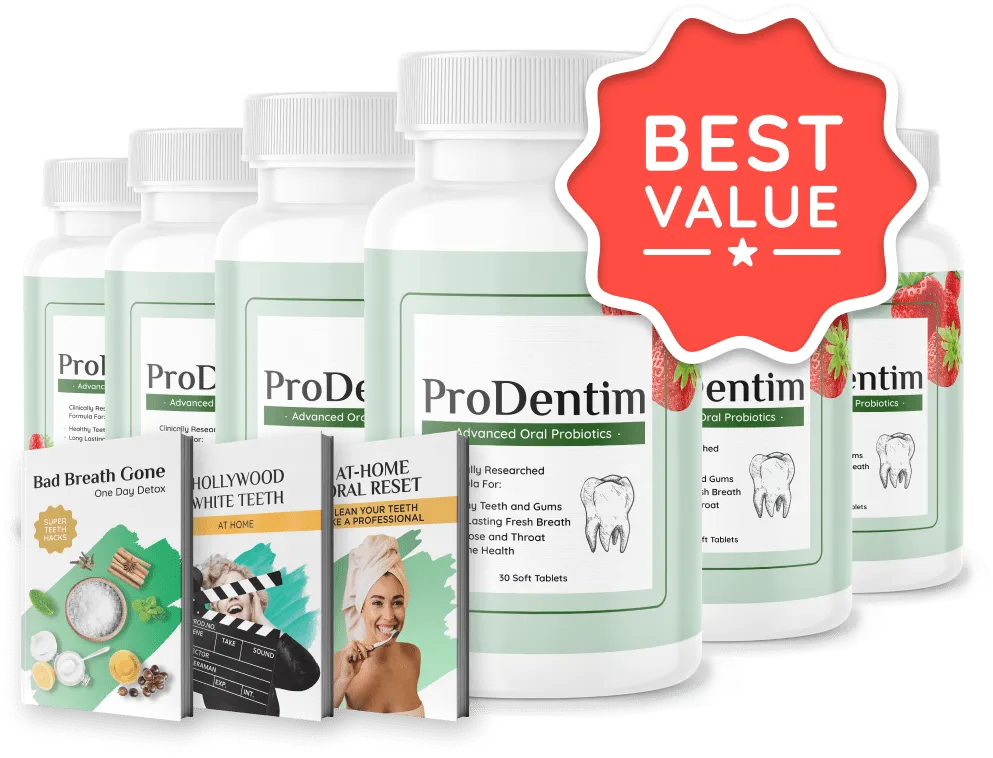
The two strains in ProDentim with the most relevant evidence here are L. reuteri (Prodentis was studied as an adjunct to scaling and root planing, with reductions in pocket depth: PMID 21523225; residual pocket maintenance: PMID 35945290) and L. paracasei for gingivitis reduction (PMID 38643116). Read the dedicated article on L. paracasei and gum science.
What probiotics will not do: regrow lost bone, reverse advanced periodontitis, or fix a tooth that already needs a root canal. They are a maintenance tool, not a rescue.
Diet and Lifestyle After 40
Sugar frequency matters more than total sugar. Six sips of soda spread across the day is worse than one full can with a meal, because each sip drops pH for roughly 30 minutes.
Hydration matters more than it did at 30. Reduced salivary flow plus reduced thirst sensation in older adults compounds. Drink water proactively, not reactively.
Mouth breathing during sleep is a hidden saboteur. Talk to your dentist or physician about it. CPAP users especially need a strategy for dry mouth.
Smoking and vaping are dose-dependent disasters for gum health. The risk reverses over years after stopping; it is never too late to quit.
Diabetes and gum disease are bidirectional. Each worsens the other. Anyone diagnosed with type 2 diabetes after 40 should be referred for a periodontal evaluation.
Warning Signs That Need a Dentist, Not a Supplement
- Gums that bleed easily and stay bleeding for more than two weeks despite improved hygiene.
- Persistent bad taste or breath.
- Loose teeth or teeth that have shifted position.
- Pus discharge at the gumline.
- Receding gums that suddenly accelerate.
- Pain on chewing.
None of these are scenarios for self-treatment. They are reasons to book an appointment.
What a Realistic Maintenance Routine Looks Like
For an adult over 40 with no active periodontitis but normal age-related changes, a defensible weekly routine looks something like this: brush twice daily with fluoride toothpaste; clean interdental spaces nightly; scrape the tongue every morning; drink water consistently; replace acidic snacks with whole foods; take a daily oral probiotic chewable; see the dentist twice a year. The probiotic is one input among many. It earns its place because it operates on a problem (microbial competition in deeper pockets) that brushing cannot fully solve.
Bottom Line on Gums After 40
Gum health after 40 is a different game than gum health at 25. The tissue is thinner, the saliva is reduced, the medications are more numerous, and the bacterial community is more aggressive. The good news is that the controllable factors are still controllable. The boring basics, done consistently, do most of the work. A daily oral probiotic like ProDentim is a reasonable adjunct that targets exactly the kind of microbial imbalance that gets worse with age. Combined with biannual cleanings and the honest conversation with your dentist about your medications, it is a thoughtful piece of an overall plan.
Editorial note: Reviewed by Dr. Emily Carter, DDS. Last updated May 12, 2026. PubMed citations linked inline. See our editorial policy.