Oral probiotics have gone from a niche curiosity to a crowded shelf in five years. Most consumers shopping for one have no way to compare products beyond price and packaging, which is the worst basis for choosing a probiotic. This guide walks through what actually matters: strain identity, CFU dose, delivery format, prebiotic support, manufacturing standards, and the questions a real buyer should ask before paying.
What Counts as a "Dental" Probiotic
A dental or oral probiotic is a supplement designed to influence the bacterial community in the mouth itself, not the gut. The distinction is important because the formats, strains, and dosing assumptions are all different. A gut probiotic is engineered to survive the stomach and seed the small intestine. An oral probiotic is engineered to dissolve in the mouth, make contact with the salivary pellicle, and temporarily compete with the resident oral biofilm. A swallowed capsule labeled "oral probiotic" misses the point.
The Six Things That Actually Matter
1. Named Strains with Designations
Look for the strain designation, not just the species name. Lactobacillus reuteri alone is not enough; ATCC PTA 5289 (Prodentis) is. Lactobacillus paracasei alone is not enough; ET-22 is. The reason: probiotic effects are strain-specific, and published trials test specific strains. A product that lists only species names is either using untested strains or hiding which strains it uses, neither of which is a good sign. ProDentim's label specifies the strains, which is the standard you should hold every product to.
2. CFU Count That Matches Studied Doses
CFU stands for colony-forming units, the count of viable bacterial cells. Oral probiotic studies typically use 1 to 5 billion CFU per dose. Anything dramatically lower is unlikely to produce measurable effects. Anything dramatically higher is not necessarily better; oral probiotic dose-response is not linear. ProDentim's 3.5 billion CFU per chewable tablet sits squarely in the studied range.
3. Delivery Format
The format must dissolve in the mouth. Acceptable options are lozenges, soft chewable tablets, melt strips, chewing gum, and probiotic-enriched toothpaste. Unacceptable for oral targeting are sealed capsules and tablets that are meant to be swallowed whole. ProDentim uses a soft chewable tablet, which is the most common format in published studies.
4. Prebiotic and Nutrient Support
Probiotics work better with a substrate to consume and an environment that favors them. Inulin from chicory root is the most commonly used oral prebiotic and has its own published trial showing oral microbiome shifts (PMID 38919384). Calcium and phosphate ions support enamel remineralization. Mild acids like malic acid can stimulate salivary flow. ProDentim includes all of these. Products that pack only probiotics without prebiotic or mineral support are missing half the formula.
5. Manufacturing Standards
Look for: cGMP certification, FDA-registered facility, third-party potency testing through expiration, and clear country of origin. "Made in USA" alone is meaningless without the certifications behind it. ProDentim claims cGMP and FDA-registered manufacturing in the United States.
6. Refund Policy
A 60-day or longer money-back guarantee with no requirement to return empty bottles is the consumer-friendly standard. Shorter windows, restocking fees, or "first bottle only" refunds are red flags. ProDentim offers 60 days. We unpack the policy in detail on our scam or legit page.
What the Marketing Will Try to Distract You With
- "Doctor formulated." Means almost nothing without a named doctor and disclosed credentials.
- "Patented blend." Patents cover novelty, not efficacy. A patent does not mean the formula works.
- "Clinically tested." Ask which clinic, which population, what sample size, and where the results were published. If you cannot find the study on PubMed, treat the claim with skepticism.
- "Trusted by 95,000+ customers." A volume claim is not evidence of effect; it is evidence of marketing reach.
- Before-and-after photos. These are almost never traceable to a specific user, a specific product, or a specific time window. Treat them as decoration.
How to Compare Two Oral Probiotics Head-to-Head
- List the strains on each label. Cross-check on PubMed: search "strain name oral OR gingivitis OR periodontitis" and skim the abstracts.
- Compare CFU per serving. Bigger numbers are not automatically better. Match to studied ranges.
- Compare format. Chewable beats capsule for oral targeting.
- Check for prebiotic and remineralizing ingredients (inulin, calcium, phosphate).
- Compare price per day of use, not per bottle. A $40 bottle with 60 doses is better value than a $25 bottle with 20 doses.
- Compare refund windows.
Who Should and Should Not Try an Oral Probiotic
Good candidates: Adults with chronic mild gingivitis, frequent bad breath despite good hygiene, recent professional cleaning who want to maintain results, peri-implant inflammation under dental supervision, and anyone whose dentist has flagged a need for biofilm management beyond brushing and flossing.
Not a substitute for, and should be combined with care from: Anyone with active periodontitis with pocket depths over 4mm, anyone with untreated decay, anyone post-surgical recovery, and anyone immunocompromised. In all of these cases, the dentist is the primary decision-maker, not the supplement.
How Long Until You Should Notice Anything
Published oral probiotic trials generally see measurable effects between weeks 4 and 12 of daily use, with the larger benefits accumulating over months. Anyone promising results in three days is selling. Anyone telling you to wait a year before evaluating is also selling. Roughly: judge fairly at 30 days, decide at 60 days. See our reviews page for typical user timelines and the realistic-expectations note at the bottom of it.
Where ProDentim Fits in the Category
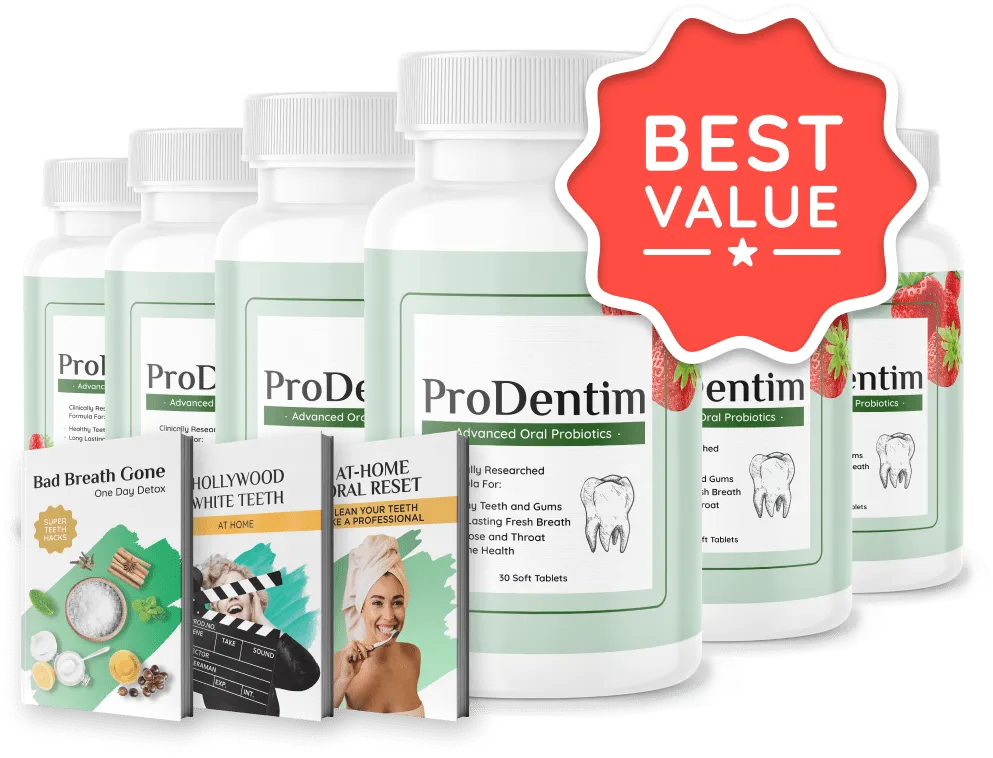
Measured against the six criteria above, ProDentim hits a high mark: named strains, studied CFU range, chewable format, prebiotic and mineral support, GMP/FDA-registered U.S. manufacturing, and a 60-day refund. It is not the only product in the category that hits these marks, but it is one of the cleaner options. The 6-bottle pack at the lower per-bottle price brings the cost-per-day to a competitive range. See our comparison page for how it stacks against generic probiotics and traditional oral care products.
Final Buying Checklist
- ✓ Strains named with designation (e.g., ET-22, BL-04)?
- ✓ CFU between 1 and 5 billion per serving?
- ✓ Dissolvable format (chewable, lozenge, gum)?
- ✓ Prebiotic and remineralizing nutrients included?
- ✓ GMP-certified, FDA-registered manufacturing?
- ✓ 60-day or longer money-back guarantee?
- ✓ Sold through the official manufacturer site to avoid counterfeits?
If you can tick all seven, you are looking at a serious product. If you cannot, keep shopping.
Editorial note: Reviewed by Dr. Emily Carter, DDS. Last updated May 12, 2026. See our editorial policy for source standards.